Top Rated Anime

Tetsujin 28-go (2004)

In post-WWII Japan, Prof. Shikishima has built up Shikishima Industries to be a technological powerhouse, working on developing robots. However, at the heart of their success lurks a dark secret from the war, something that cost the life of Prof. Kaneda, the mentor of Prof. Shikishima. Now Kaneda's son, Shoutarou, is about to learn the truth, and it will change him forever.
(Source: Anime News Network)

Tetsujin 28-go: Hakuchuu no Zangetsu

This theatrical version based on the manga by Yokoyama Mitsuteru, deals with the genius boy detective Kaneda Shotaro and his giant robot, Tetsujin 28, set in Tokyo ten years after the end of the Second World War.
Shotaro's missing brother appears as a a new character who was trained as a pilot of the soldier robot Tetsujin which Japan had created for the Second World War. However, with the end of the war, there was nothing left for him but a peaceful Japan. In the meantime, "Destruction Bombs" are found in many places in Tokyo. The bombs were developed by Professor Kaneda, the creator of Tetsujin 28 and Shotaro's father, as the ultimate weapons to protect the mainland. If the bombs explode, Tokyo will be reduced to ashes.
(Source: AniList.co)
Tetsujin 28-gou Gao!

This series of anime shorts, roughly five minutes in length, will focus on protagonist Shoutarou Kaneda's everyday life instead of focusing on battle scenes as previous Tetsujin 28 titles have done. The visuals of the title robot, its nemesis Black Ox, and other elements will have a pop-art style.
(Source: Anime News Network)
Tetsuko no Tabi

Based on a seinen manga by Kikuchi Naoe and Yokomi Hirohiko, serialised in IKKI.
The "story" is that a manga artist is asked by her boss to accompany him and a travel-writer on various train trips around Japan and draw a manga about it.
The kicker though, is that it's completely non-fiction —the creator really did go on all these trips, and the manga simply records what happened, with no embellishment. There's a little disclaimer at the front that says "This is non-fiction, so I apologize for the lack of drama," and indeed, it mostly is just about them riding trains from place to place, waiting on platforms, etc.
The "travel writer" turns out to be a super train-otaku who has vast knowledge of the train network, but also micro-manages all their trips, planning every detail down to the second. He cares mostly about following the schedule and successfully achieving his planned goals (e.g. visiting all stations on a line in a completely bizarre order to accomodate infrequent trains). The mangaka doesn't really care about trains; she's cynical, sarcastic, and rather lazy (she mainly just looks forward to the next eki-ben); he's completely gung-ho as long as he's following the schedule, and the inevitable conflicts are pretty entertaining.
Throughout, though, it feels real —if you've travelled by train in Japan it will all seem very familiar, not just the scenery, but also the atmosphere and feel— and the artist does a great job of pacing and applying little tweaks to keep it consistently entertaining. In an additional bit of recursiveness, some of the characters who show up in the manga (who of course are real people, who really did show up) do so because they (really) read previous episodes of the manga!
In addition of course, you can learn about various out of the way and interesting Japanese train lines and stations; some of them really do look cool. There's always this vague sense of surreality about it however, the trips are all planned by the train-guy (goal: visit all 9,843 stations in Japan) who seems to consider everything as part of a checklist rather than an experience to be enjoyed. You learn a bit about train-otaku culture too; there's really only the one guy in the story, but train-otaku culture is a sort of constant peripheral presence.
(Source: AniDB)
Akihabara Dennou Gumi

A "patapi" is a cute mechanical creature which is like a cyber pet. It can eat, sleep, play, and even help out its owners with some stuff. When Hibari Hanakoganei receives a patapi from a prince in her dreams, she is thrilled and names it "Densuke". When mysterious forces try to steal Densuke, Hibari discovers that Densuke is not just an ordinary patapi. Densuke has magical powers that allows it to transform into a powerful cyber-fighter who looks like Hibari. Hibari's friends also receive similar patapis, and together they form the Cyber Team in Akihabara.
(Source: AnimeNfo)
Tetsuro no Kanata

A boy encounters a trace of his lost father on tracks where time comes and goes, at a station where time stops. With the help of a mysterious projectionist, the boy and station master search for the truth of the father's image.
(Source: AniDB)
Tetsuryou! Meet with Tetsudou Musume
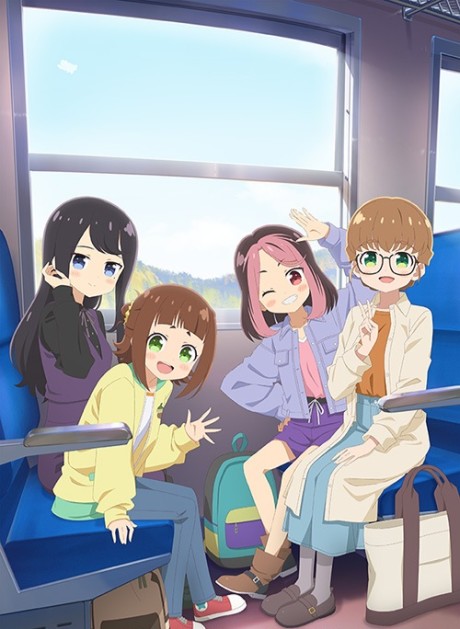
"I want to escape my daily routine and go on a trip somewhere." I've thought that many times. Days when I don't even know what I want to be in the future. But someday, I want to find something I can get really into.
As the campus was buzzing with excitement at the start of a new day, the members of the Railway Travel Club (commonly known as the Tetsuryou-kai) reached out to Misaki. As the world spreads out through the tracks, her heart begins to beat faster!
As the Tetsudou Musume (Railway Girls) celebrate their 20th anniversary, the Tetsuryou-kai travels their world in search of excitement.
(Source: Official Site, translated)
Tetsuwan Atom

In the distant year 2003, Japan is a technological utopia, and robots are everywhere. One such robot, Tobio, was built by the brilliant Dr. Tenma to replace his dead son. But when it soon becomes apparent that Tobio is an imperfect copy of his departed child, Dr. Tenma throws him out. He is rescued from the scrap heap by the benevolent Professor Ochanomizu, a crusader for robot civil rights. Now the little robot, renamed Astro Boy, is given a mission to defend Japan and the world from all manner of sinister threats. Using his seven super-abilities and 100,000 horsepower worth of strength to battle evil, Astro hopes to set an example to the world of the good which all robots are capable of.
Doteraman

In a small town of Tokyo there lives a middle-aged man, Suzuki, who spends commonplace days conducting a small business. He is ambitious to become such a celebrity as to appear on the cover page of a popular magazine.
One day he happens to discover a mysterious entrance that leads to an alien space. Through it he reaches the world of goblins and attaches control devices to goblins there to make them act at his free command. Capitalizing on those zombies, he grows outrageous and notoriously sets his hand to evil things. Meanwhile two witty pupils, Hajime and his girl friend Mariko, come across a strange alien detective who presents them with Doteraman garments. Wearing those garments, they transform themselves into Doteraman and Doterapink with supernatural strength. Then they challenge the wicked ruler and successfully liberate the poor goblins. They continue to fight in the cause of justice creating excitement and entertainment full of pleasure.
(Source: AniDB)
Dotanba no Manners

An introduction to etiquette through the hapless antics of Mr. Dotanba, who manages to put his foot in it in innumerable social situations.
(Source: Anime News Network)
Tetsuwan Atom: Ao Kishi no Kan

The film begins with the Phoenix retelling the tales and hopes of Astro Boy. Many of the visual being directly taken from the 1980s TV series as it recaps some of his adventures.
Following this recap, Astro Boy confronts Blue Bon and tries to convince him to change his mind about the humans. But Blue Bon misunderstands, assuming that if Astro Boy does not agree then he is an enemy. Blue Bon hates humans because they broke apart his family (Maria and Tonto). A battle begins between the two after Astro Boy fails to convince Blue Bon that they aren't each others' enemy.
(Source: Astro Boy Wiki)
Tetsuwan Atom: Atom Tanjou no Himitsu

Doctor Tenma, chief of the Ministry of Science, brought a digital brain genome from an aircraft. Doctor Tenma begins a trip to Mars, then combines the genome with a robot. Doctor Tenma's son, Tobio, who had died in a traffic accident, has been revived.
(Source: AstroBoy Online)
Tetsuwan Atom: Chikyuu Saigo no Hi

Astro Boy, helping Professor Ochinomizu with planetary exploration, discovers a trash star floating in space. On this star, robots that can no longer move have been thrown away stacked on top of each other. On this robot mountain, Astro saves a robot soldier, Bemu, that escaped from the verge of death and takes him back to Earth.
"I'm tried of fighting!" "I feel the same." While Atom and Bemu are together, a warm friendship is born and goes on to deepen. However, one day, the trash star draws near to the Earth. If it hits, the Earth would have a huge explosion. The Earth is in chaos. As this happens, there is just one way to stop the crash into Earth. Only this is... What will Astro do. Will he be able to protect a peaceful Earth as well as his friendship with Bemu?
(Source: Astro Boy Wiki)

Tetsuwan Atom: Uchuu no Yuusha

From the TV series of "Astro Boy," three episodes were selected for theater re-edition, "Robot Rocket" (46th episode), "Earth Defense Troops" (56th episode) and "The Last Day of Earth" (71st episode). Of these three, "Earth Defense Troops" was the only one originally derived from Tezuka Osamu's story "Number 7." Its settings were diverted to the "Astro Boy" series. In this film, the whole scene of "Earth Defense Troops" and a part of "The Last Day of Earth" were reproduced in color for this theater version.
(Source: Official site)

Akichi Asobi

A boy is always alone, at school, or at home. One day, he finds a sandlot on the way home and thinks of making a ‘town’ of his own. Another boy was watching his play and starts to imitate him.
1st year work 2013, Tokyo University of the Arts, Graduate School of Film and New Media, Department of Animation
(Source: Geidai Animation)